

The next step in electromobility
The next step in electromobility
A battery collector is a key component of a battery system. It provides the electrical interconnection of individual cells, facilitates the transmission of measurement signals to the Battery Management System (BMS), and serves as a precisely defined interface between the battery cells and the control electronics. The final product is a multi-layer assembly consisting of thin conductive materials, insulating layers, and flexible electronics, the relative positioning of which must be maintained with exceptional precision.
The greatest technical challenge of the project is not the assembly itself, but the handling of the individual components. Thin conductive layers possess minimal inherent rigidity and are highly susceptible to deformation or relative displacement. Consequently, the automation design required the development of specialized handling fixtures, precision positioning mechanisms, and process workflows to ensure the repeatability of the manufacturing process while maintaining the high quality of the final assembly.
Quality control integrated directly into the production line is another key component. In addition to the precise alignment of the individual layers, the system performs electrical testing of the conductive paths and the insulating properties of the assembly. Furthermore, each product is uniquely identified via laser marking, enabling full traceability throughout the manufacturing process.
The project also imposes specific requirements regarding production cleanliness. When working with conductive materials, even minor contaminants or metallic particles can compromise the final functionality of the product. Therefore, the technological design incorporates controlled cleaning, the elimination of electrostatic charges, and rigorous monitoring of the production environment during all assembly operations.
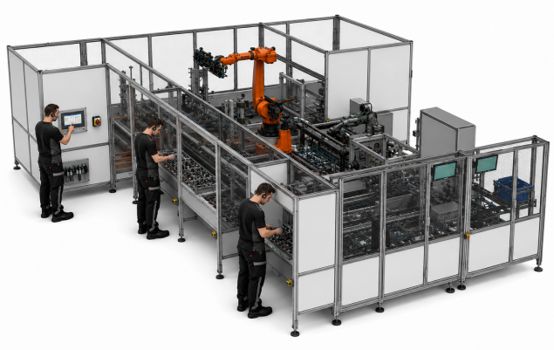
The design of the entire production line reflects the complexity of the product itself. At its core is a precision pallet conveyor system that transports pallets—carrying components over a meter in length—where repeatable positioning is essential for subsequent assembly and testing operations. For instance, handling between two stations is performed by the manufacturer’s largest SCARA robot, whose operational reach allows for the efficient servicing of an extensive production area. Specially designed for this project are interchangeable gripping systems—exceeding 1,000 mm in length—that combine dozens of mechanical grippers and vacuum suction cups. These systems enable the safe handling of large yet highly delicate multi-layer assemblies. The entire production process takes place within a strictly controlled ESD (electrostatic discharge) zone, minimizing the risk of electrostatic discharges that could damage sensitive electronic components.
The production line also incorporates automated cleaning operations and the final palletizing of finished products into transport blisters, ensuring safe handling and protection during subsequent logistics.
Another key component of the production line is a comprehensive system for camera-based inspection and precise 3D measurement. At various stages of production, the system verifies the correct orientation, presence, and positioning of all components, the quality of their placement, and the final geometry of the assembly. By combining 2D camera systems with 3D measurement technologies, even the slightest deviations—which could potentially affect the functionality of the final product—can be detected. Consequently, every part undergoes continuous automated inspection before moving on to the next operation, preventing any non-conformities from propagating to subsequent production phases. This ensures a high level of process reliability, full production traceability, and consistent quality that meets the rigorous demands of the modern electromobility sector.
The project is currently in the assembly and commissioning phase. The process involves the integration of mechanical assemblies, electrical installations, and control system programming, as well as the commissioning of robotic workstations and initial functional testing of individual technological stations. The implementation team includes mechanical and electrical designers, PLC and robot programmers, assembly technicians, and service specialists; their close collaboration is fundamental to the successful completion of the project.
Projects of this nature demonstrate that KROFIAN is capable of delivering technologically advanced automation solutions, even for the most demanding applications in today’s industrial landscape. By combining in-house development, design, manufacturing, and commissioning, the company creates equipment that meets rigorous standards for precision, quality, and long-term reliability.